
Second brain — what actually matters
After a year of running everything from a folder of markdown files, the lessons fit on ten sticky notes. The one that matters most — plain text + git = memory that compounds.
My second brain is not an app. It's a folder of plain text files on my laptop.
All my companies, numbers, ideas and decisions live there. AI agents read it, write to it, and run the routines every morning: today's numbers, receipts, stats, the to-do list. I've written before about why it's a folder. This is the follow-up: after a year of actually living in it, which parts turned out to matter.
I put the answer on a cork board.
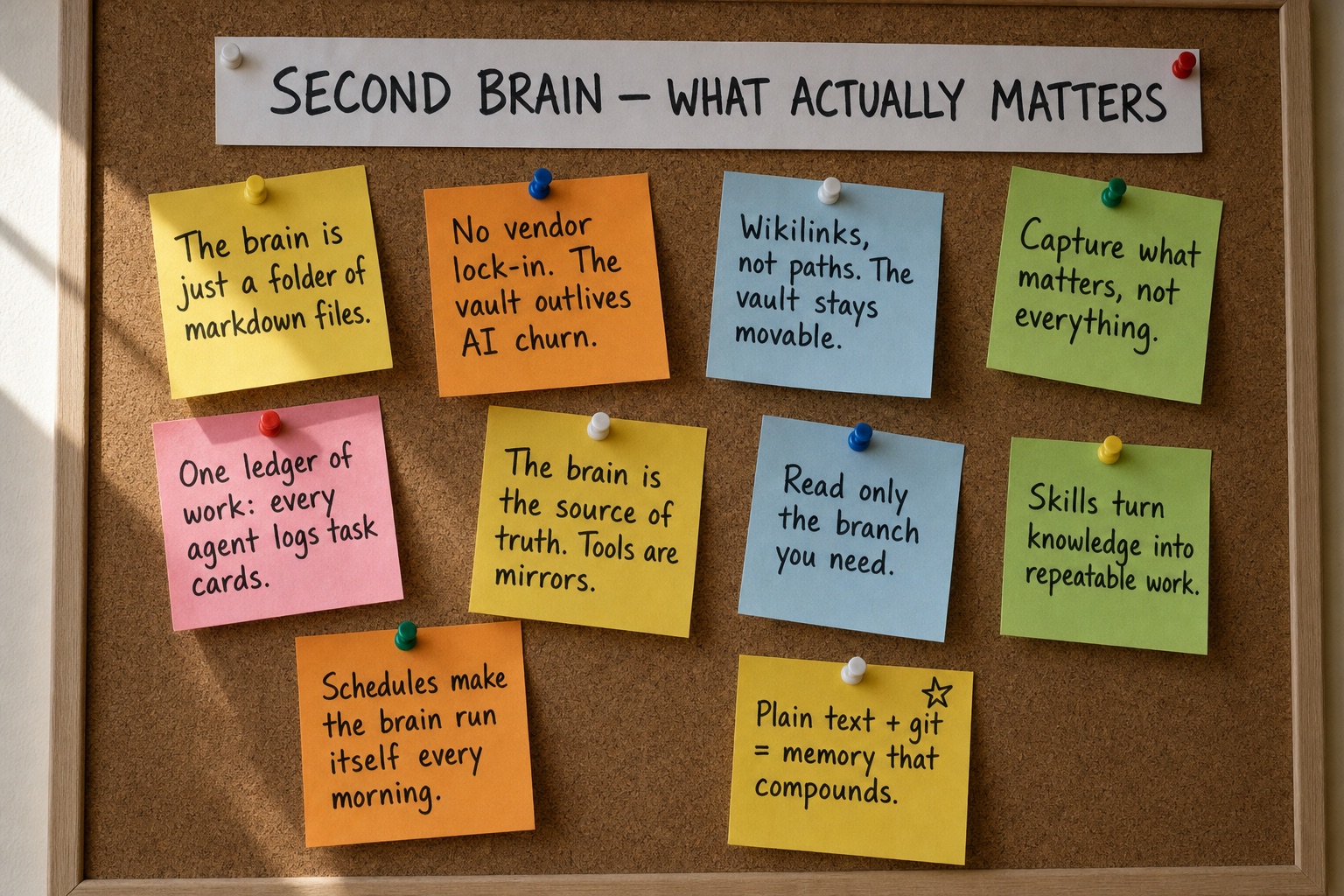
Ten notes. Everything else was noise.
Own the layer that doesn't move
The first three notes are the same lesson from three angles. The brain is just markdown files, so there is no vendor lock-in — the vault has already outlived several rounds of AI churn. Models got replaced, tools came and went, the folder didn't notice.
Links between notes are wikilinks, not file paths. That sounds like a detail, but it's what keeps the vault movable: I can reorganize folders, rename things, sync it anywhere, and nothing breaks. The structure lives in the text, not in the tool displaying it.
And the vault is the source of truth. Obsidian, Claude Code, whatever reads it next — those are mirrors. If a tool and the vault disagree, the vault wins.
Keep it lean
The mistake everyone makes with a second brain is capturing everything. Mine got better when I started capturing less: what actually matters, not every article I skimmed. A vault full of noise is just a second inbox.
Same rule when reading. An agent doesn't load the whole vault to answer a question — it reads only the branch it needs. That's what keeps a folder with thousands of notes fast to work with.
Make it run itself
Three notes are about turning the vault from a filing cabinet into a machine.
Every agent, no matter which project it works on, logs its work in one ledger — task cards, one per finished thing. One place to see everything that got done, by me or by an AI, across all companies.
Skills turn knowledge into repeatable work. Once I've figured out how to do something — publish a video, close the books, prep an outreach email — the steps become a skill file any agent can execute. Knowledge you wrote down once, work you never explain twice.
And schedules make the brain run itself. Every morning, before I'm at the desk, agents have already pulled the numbers, filed the receipts and drafted the day. The vault isn't something I maintain. It's something that reports to me.
The note with the star
Plain text + git = memory that compounds.
That's the whole thing. Every day I feed it, the vault becomes more valuable — more context, more history, more for the agents to stand on. And because it's text under version control, switching AI tools tomorrow costs nothing: everything comes along. No lock-in, no migration, no hostage situation.
What I actually use it for
Sticky notes are principles. Here's what they look like in practice:
- Newsletters that send themselves — and learn from what gets opened and what sells, so the subject lines keep improving. Every email a little better than the last.
- Sales and analytics in one place — collected from every website and every social account, across all companies.
- Full insight into my email — I never miss an important message, and the brain drafts replies when I want it to.
- Every graphic profile, logo and tone of voice logged once, per company — I never have to tell it where a logo, file or document lives. Ever again.
- Answers to "why did sales go up?" — it knows which newsletters went out, whether I posted more or less, which kinds of posts actually sell. Insights that used to take hours of digging are now one question.
- Automated receipt handling — it scans my mail daily for receipts and invoices, ready to book in the right company.
And more. The sky is the limit. The hard part is getting started — once you do, you never go back. The value is in the context of your world and your data, not in which AI tool you use.
Most people are collecting subscriptions. I'd rather compound a folder.